Basic Information
| Field | Details |
|---|---|
| Full name | Eva Barbara Fegelein |
| Also known as | Evi Fegelein; Eva Barbara Fegelein-Berlinghoff |
| Born | 5 May 1945, Obersalzberg, Bavaria, Germany |
| Died | 8 April 1971 (commonly cited) |
| Age at death | 25 |
| Parents | Margarete “Gretl” Braun (1915–1987) and Hermann Fegelein (1906–1945) |
| Step-father | Kurt Berlinghoff (married Gretl in 1954) |
| Named after | Eva Braun (aunt) |
| Siblings | None documented |
| Burial name | Eva Barbara Fegelein-Berlinghoff |
| Notable for | Born in the final days of WWII; daughter of Gretl Braun and SS-Gruppenführer Hermann Fegelein |
Origins at Obersalzberg: A Birth in the Final Week
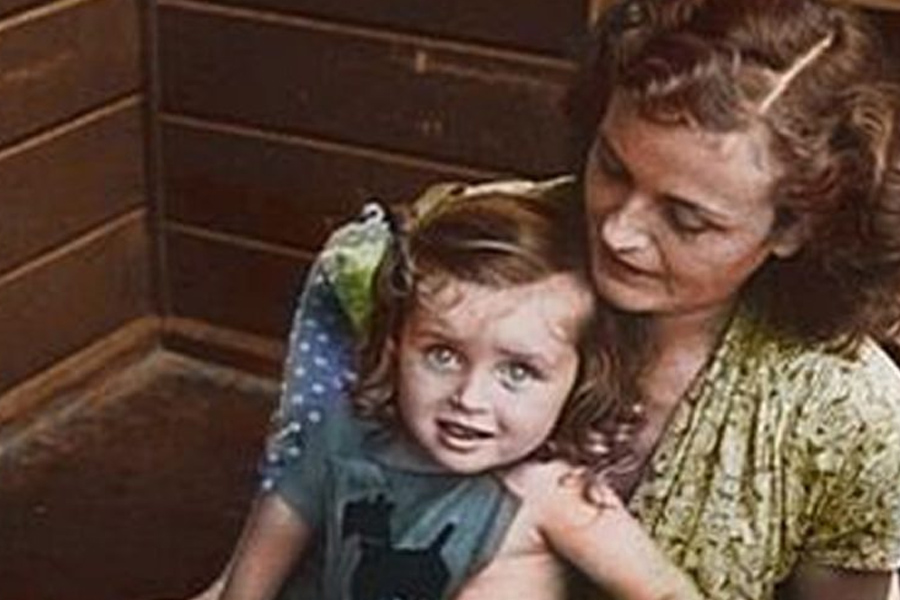
Eva Barbara Fegelein entered the world on 5 May 1945—five days after Adolf Hitler and her namesake aunt, Eva Braun, died by suicide; a week after her father’s execution in Berlin; and three days before Germany’s unconditional surrender took effect. Her birthplace, Obersalzberg, had been a social and political hub of the Nazi elite. By the time she was born, it was a ruin-strewn landscape, a symbol of a regime collapsing in on itself.
In that setting, the newborn—tiny, unnamed beyond a family memory—was given the name Eva Barbara. It was a choice that tethered her to a family story already stamped into history’s ledger: the Brauns of Munich and the ambit of the Berghof, the Fegeleins of equestrian repute turned SS prominence, and a Europe in ashes. Her life began at the edge of an era—one that had just ended in catastrophe.
Parents and the Shadow of Power
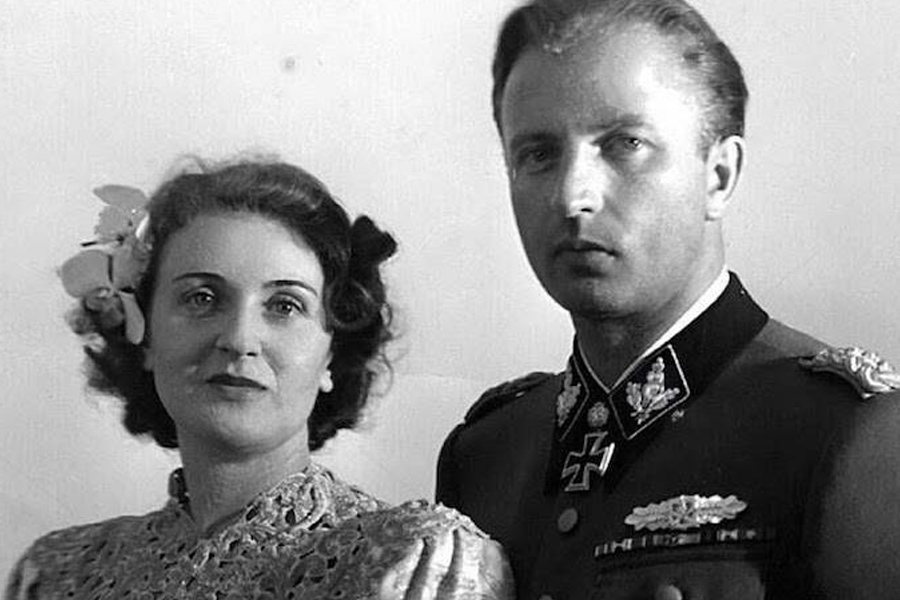
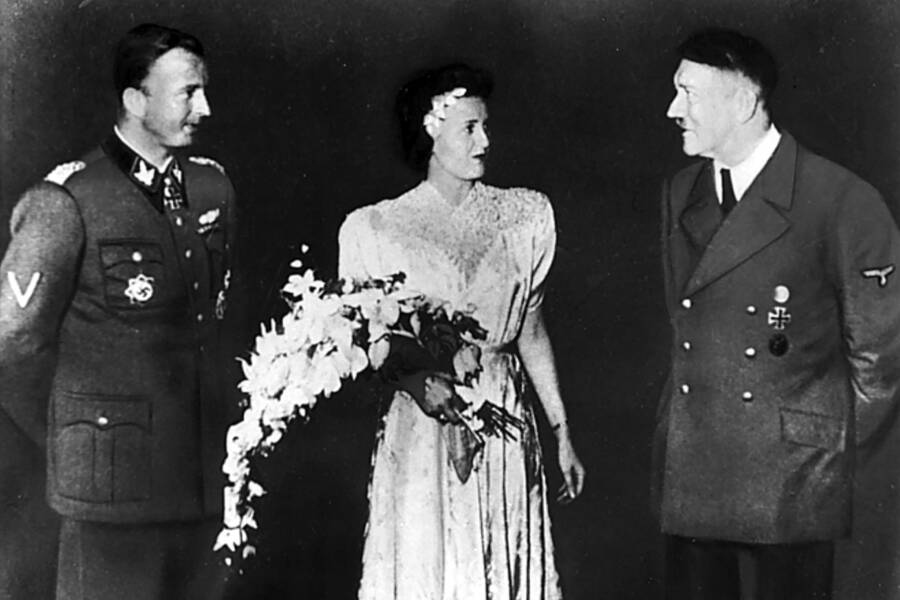
Her mother, Margarete “Gretl” Braun, born 31 August 1915, was the youngest of the three Braun sisters—Ilse, Eva, and Gretl—daughters of schoolteacher Friedrich “Fritz” Braun and seamstress Franziska “Fanny” Kronberger. Gretl worked for photographer Heinrich Hoffmann and moved within the social orbit that gathered around the Berghof in Berchtesgaden. On 3 June 1944, she married SS-Gruppenführer Hermann Fegelein at Salzburg’s Mirabell Palace, a ceremony attended by the most powerful figures of the collapsing Reich.
Hermann Fegelein, born 30 October 1906, had risen quickly in the Waffen-SS, linking his equestrian background—and his father Hans Fegelein’s riding school—to the regime’s propaganda and patronage networks. In the final act, he served as Himmler’s liaison in Hitler’s headquarters. Arrested for desertion amid the chaos of April 1945, he was executed in Berlin on 28 April. The image is stark: a father executed one week before his daughter’s birth, a mother left to navigate a shattered landscape with a newborn and a surname no longer safe to speak aloud.
On the maternal side stood Eva Braun, the aunt who married Hitler hours before their joint suicides; and Ilse Braun, the middle sister who survived the war. On the paternal side were the Fegeleins—Hans, the retired Oberleutnant and horseman, and Waldemar “Axel” Fegelein, Hermann’s brother, who survived the conflict. The web of relationships was dense, but after 1945 most of it retreated into private life.
Aftermath and a New Surname: Life with the Berlinghoffs
Post-war Bavaria favored quiet reinvention. In 1954, Gretl married Kurt Berlinghoff, and with that union the child born amid rubble acquired a steadier household and, in many records, a hyphenated surname: Fegelein-Berlinghoff. The hyphen can read like a bridge—between the notoriety of her father’s name and the ordinary, post-war respectability of her step-father’s.
Little is recorded about Eva Barbara’s schooling, interests, or work. Unlike her notorious relatives, she did not inhabit the spotlight, and Germany in the 1950s and 60s did not encourage the children of the Third Reich’s inner circle to become public figures. The paper trail is brief: family mentions, the surname shift, and the census of cemeteries.
A Short Life, Sparse Records
The best-known factual bookends are her birth and her death. The most commonly cited date for her death is 8 April 1971. She was 25. Many accounts state she died by suicide, with some reporting that it followed the death of a boyfriend in a car accident—details that appear in family and genealogical notes more than in formal archives. A life already private ended privately.
The lack of documentation does not diminish the poignancy. It intensifies it. Her story is like a photograph with the exposure set too low: shadows, outlines, and a few sharp highlights, but no flood of detail. She was the child born into a void, raised in the long, gray aftermath, and remembered most of all for the timing of her arrival.
Family at a Glance
| Relative | Relation to Eva Barbara | Lifespan | Notes |
|---|---|---|---|
| Margarete “Gretl” Braun | Mother | 1915–1987 | Youngest Braun sister; married Fegelein (1944), then Kurt Berlinghoff (1954). |
| Hermann Fegelein | Father | 1906–1945 | SS-Gruppenführer; executed in Berlin on 28 April 1945. |
| Kurt Berlinghoff | Step-father | — | Married Gretl in 1954; surname appears in Eva Barbara’s burial records. |
| Eva Braun | Maternal aunt | 1912–1945 | Hitler’s companion and brief wife; died 30 April 1945. |
| Ilse Braun | Maternal aunt | 1909–1979 | Survived the war; remained largely private. |
| Friedrich “Fritz” Braun | Maternal grandfather | 1879–1964 | Schoolteacher in Munich. |
| Franziska “Fanny” Kronberger | Maternal grandmother | 1885–1976 | Seamstress; mother of the three Braun sisters. |
| Hans Fegelein | Paternal grandfather | — | Retired Oberleutnant; ran an equestrian school. |
| Waldemar “Axel” Fegelein | Paternal uncle | 1912–— | Waffen-SS officer; survived the war. |
A Timeline in Numbers
- 31 Aug 1915: Birth of Margarete “Gretl” Braun in Munich.
- 30 Oct 1906: Birth of Hermann Fegelein.
- 3 June 1944: Gretl Braun marries Hermann Fegelein in Salzburg.
- 28 April 1945: Execution of Hermann Fegelein in Berlin.
- 30 April 1945: Deaths of Adolf Hitler and Eva Braun.
- 5 May 1945: Birth of Eva Barbara Fegelein at Obersalzberg, Bavaria.
- 7–8 May 1945: German surrender signed and comes into effect.
- 6 Feb 1954: Gretl marries Kurt Berlinghoff; the family settles into post-war Bavaria.
- 8 April 1971: Commonly cited date of Eva Barbara’s death.
- 10 Oct 1987: Death of Margarete “Gretl” Braun.
Context and Character: Between History’s Floodlights
To write about Eva Barbara is to work in the negative space of history. The floodlights glare on her parents and aunt, but they fall short of their child, who grew up in a society rebuilding itself and renegotiating its memory. She carried a name freighted with historical gravity. She also carried the ordinary burdens of adulthood—relationships, the search for work and meaning—in a country navigating silence, guilt, and renewal.
Her hyphenated surname, Fegelein-Berlinghoff, became a kind of ledger: the past on one side, the present on the other. The public record is spare because her life appears to have been spare of public ambitions; it was domestic, local, human. In that sense, she stands for thousands in post-war Germany whose stories never entered the archives, yet whose lives were shaped by the long, cold shadow of 1945.
FAQ
Who were Eva Barbara Fegelein’s parents?
She was the daughter of Margarete “Gretl” Braun and SS-Gruppenführer Hermann Fegelein.
When and where was she born?
She was born on 5 May 1945 at Obersalzberg in Bavaria, Germany.
How old was she when her father died?
She was born one week after his execution on 28 April 1945, so she never knew him.
Did she have any siblings?
No siblings are documented in public records.
Why is she sometimes called “Fegelein-Berlinghoff”?
After Gretl married Kurt Berlinghoff in 1954, Eva Barbara appears in family and burial records with the hyphenated surname.
How and when did she die?
She died by suicide, commonly cited as 8 April 1971; some details vary in secondary compilations.
Was she named after Eva Braun?
Yes, she was named for her aunt, Eva Braun.
Did she have a public career?
No public career or notable professional activity is recorded for her.
Where is she buried?
She is recorded under the name Eva Barbara Fegelein-Berlinghoff and is interred in Bavaria alongside family.
What became of her mother, Gretl?
Gretl lived quietly in Bavaria after 1945, remarried in 1954, and died in 1987.